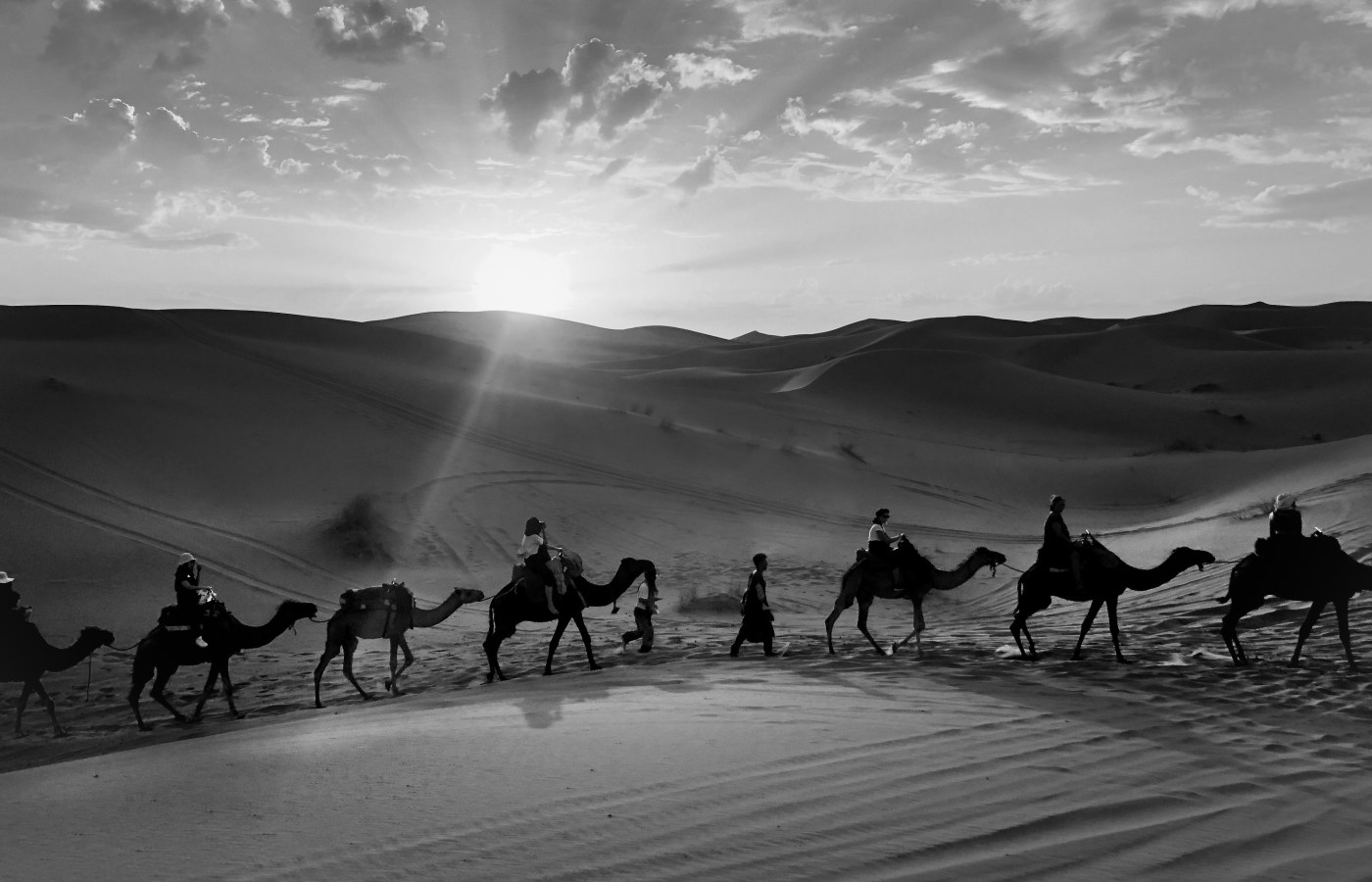
If I closed my eyes, the sharp August heat and my camel’s rocking pace could be mistaken for the horses I rode at summer camp in Texas. Not even the most vivid recollection, though, could mask the smell, the stillness, the power of the Sahara desert which stretched around me like orange waves in every direction.
My camel was tied by its nose to a line of other camels carrying other tourists. As we climbed a towering dune, I tried to look past the young German man directly in front of me – his jean shorts and baseball hat spoiling my illusion of timelessness.
Instead, I focused on the setting sun which stretched out our camels’ shadows like a Dali painting on the sand.
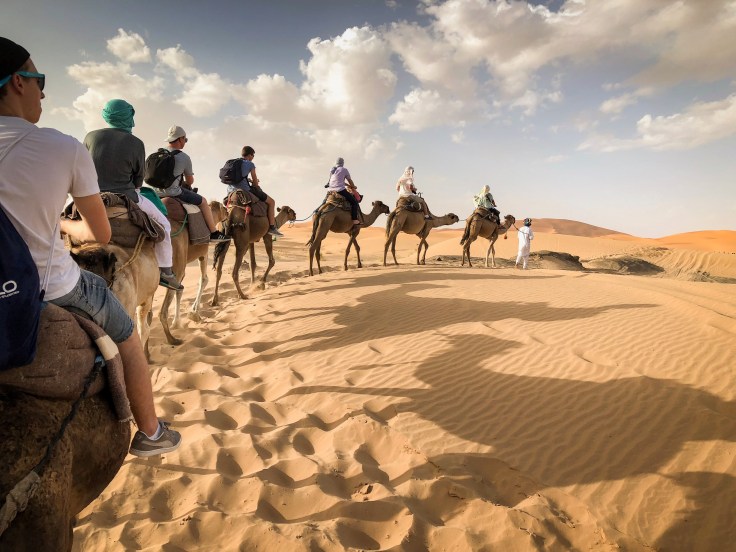
We rode for over an hour. The horizon cooled from burning orange to a dim blue and the less-timid stars were beginning to stretch their rays as we dismounted our camels and walked with unsteady legs into a cloth-walled fortress – our camp.
The leader of our expedition – a young Moroccan man with short, thick dreadlocks wearing the flowing, white garb of a traditional Berber man – funneled us into the center of the camp where blankets and pillows were laid out to create a giant, communal mattress.
I had spent time in the desert before – the Mojave in California. I call them both by one name – “the desert” – because I have found that despite many differences, all deserts are made from the same energy.
Laying out on the blanket floor amongst strangers and friends I began to feel it – my shallow lungs widening, easing open to hold deep, unfettered breaths.
Then, dizzy with freedom, I let the night embrace me in a whirling waltz. I found myself running, tumbling, flying down a mountainous sand dune, dancing in the rain to the beat of Berber drums and sitting under the stars with a man I had just met, letting words and thoughts float between us like feathers.

“Everyone here is named Zaid,” he said as he introduced himself late into our conversation, “it means ‘to prosper’ and so everyone gives this name to their firstborn son.”
Zaid was born into a nomadic, Berber family. They wandered the Sahara desert for the first 14 years of his life.
“We ate only bread, dates, and water,” he told me, doubling down when I expressed my disbelief, “and, I never owned a pair of shoes until last year.”
Zaid explained that he didn’t view these circumstances as hardships when he was young – it was just the way things were.
In fact, he was angry, at first, when his parents decided to give up the nomadic life and settle in Merzouga – a small town in the shadow of the Sahara – where their children could enjoy more possibilities.
“Do you still miss it? The nomadic life?” I asked.
“It was a hard way to live…” I couldn’t see his face in the dark but I could hear the smile in his voice, “but I miss the freedom.”
Working for the tour company had given him a lot. Though he had never gone to school, Zaid learned to speak six languages by listening to tourists who had come from every corner of the world to visit his backyard. He was grateful but, he explained, the daily sameness of his job was often confining.
As Zaid and I spoke, I buried by bare toes in the cool sand and laid back to embrace the stars in their full splendor – so much brighter than at home.
I knew my experiences could not compare with Zaid’s but I couldn’t help relating so completely to what he was saying. Somehow, we were both victims of the same wandering spirits, knocking within our ribs like frantic birds. Life had given us a taste of her sweetest nectar. How, now, were we supposed to live without it?
The next morning I was shuttled on to my return journey – perched atop a camel before the sun had colored the sky. Clouds that had emptied a small desert rain upon us the night before now stretched their weary forms into wisps that resembled the swirling thoughts of my mind.
An hour later, high Sahara dunes gave way to rocky, beige flatlands and we tourists shifted in our saddles trying to protect our tendered bums. Our destination was growing near, and I cast a longing glance behind me at the orange sands in the distance – wishing for more time.
“When did your family know it was time to move on?” I had asked Zaid the night before.
He’d answered plainly and practically, “We left when there was no more food to be found.”
Was there still food for me in the Sahara? The question lingered in the dry air as my camel trodded onward.
 Travel Like Bird
Leave a comment